
The OODA Loop emerged as an American military theory and then evolved to become a global doctrine in combat and management. The loop represents the life cycle and victory in the era of rapid decision-making
When decision-making becomes a lethal weapon leading to military superiority, it radically changes the rules of engagement and planning on battlefields, and its influence extends to the fields of management, finance, and business.
It was formulated by U.S. Air Force Colonel John Boyd in the 1970 and became known as one of the most important strategic models that revolutionized decision-making in high-risk, rapidly changing combat environments. Known as the "OODA Loop," it emerged as an effective military theory to achieve superiority over the adversary, transforming into an operational philosophy decisively applied in combat operations and battle management. It later evolved to be widely adopted in business management, becoming one of the key principles of successful management to improve decision-making processes in commercial institutions.
The Concept of the OODA Loop؟
During his service in the U.S. Air Force, Colonel John Boyd investigated the reasons for the success of American F-86 fighter pilots against MiG fighters during the Korean War. He concluded that the technical specifications of the fighters were a crucial factor, particularly the wider field of vision compared to MiG aircraft. Additionally, the hydraulic control systems in F-86s enabled extremely rapid maneuvers, giving pilots a clear superiority advantage in air engagements. However, based on his practical experience as a fighter pilot, he realized that the secret to superiority lay not only in the technical and combat capabilities of the fighter aircraft but also in the pilot's ability to make engagement decisions faster and more accurately than the opponent, ensuring a competitive edge in high-speed air warfare. This initial analysis formed the foundation of his theory, later named the OODA Loop.
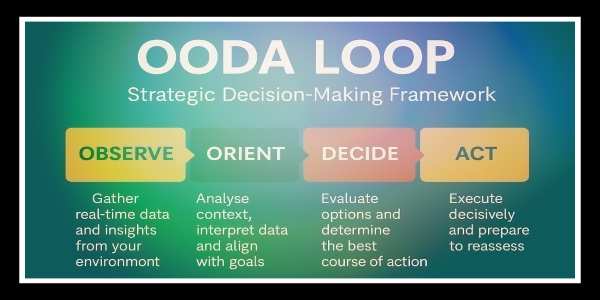
Stages of Implementing the OODA Loop.
The name OODA comes from the initials of the four stages of the loop in military and strategic contexts:
- Observation (Observe): During this stage, individuals and organizations gather data and information about their operational environment from various available sources: visual sight, radar, sensors, intelligence reports, and others. It is the stage of perceiving the current reality of the situation and greatly influences the effectiveness of subsequent steps.
- Orientation (Orient): This is the most critical and complex stage, involving the analysis and interpretation of observed data in light of experience, culture, technology, and strategic objectives. Here, specifically, the mental picture of the situation is built.
- Decision (Decide): Here, intent intervenes to formulate the hypothesis of action and select the next step. It does not mean the final decision but rather the intent to act, for example, "I will perform a right turn maneuver."
- Action/Execution (Act): This is the stage of actually executing the decision made in the third stage. Once executed, the loop restarts with "Observation" to evaluate the results of the action.
The OODA Loop theory is based on the idea that conflict, whatever its form, is essentially a bold decision to preempt the opponent's decision loop—meaning the actions the competitor might take to avoid implementing and imposing your loop on them. To succeed, acting with utmost speed in decision-making and actual execution is paramount. Hence, the OODA Loop idea emerged as a rapid cycle that repeats and only ends with the conflict's conclusion—it is a cycle of survival, life, and victory. It occurs in a short time and tolerates no delay, as there is an opponent lying in wait.
In developing these mental models, strategist Boyd emphasized the importance of adaptability and flexibility in decision-making, especially in situations where the environment witnesses continuous change and evolution.
The OODA Loop and Combat Operations: A Race Against Time.
In the context of combat operations, whether in air warfare or otherwise, the OODA Loop's goal is to enter the opponent's loop effectively and disrupt their plan. This means the commander or fighter completes their full cycle (Observation, Orientation, Decision, Action) faster than the opponent to overcome them.
If Fighter (A) completes their loop in 10 seconds, and Fighter (B) in 15 seconds, Fighter (A) will always be one step ahead of their opponent. This temporal superiority leads to decisive results in resolving the engagement according to the following points:
Disrupting the Opponent: When the opponent receives a new action from you before completing their previous decision cycle, they are forced to re-observe and re-orient to the new situation. This requires quick actions in a limited time, slowing their loop and paralyzing their thinking and steps.
Creating Chaos and Ambiguity: Execution speed overwhelms the opponent with a flood of information they cannot process quickly, losing the ability to build a clear picture of the situation and starting to make delayed or erroneous decisions.
The Strategic Application of the Loop and the Future.
The OODA Loop forms the cornerstone of modern military doctrines and warfare patterns, especially in concepts like "information warfare" and "network-centric warfare." Armies with faster and more effective communication networks for information transfer conduct operations in real-time, directing their forces to win and resolve the conflict in their favor. This led aircraft designers to improve and develop the technical and combat capabilities of the latest American fighter models, focusing on high maneuverability and rapid response.
With the emergence of artificial intelligence and modern technologies, the OODA Loop has been developed and accelerated to unprecedented levels to adapt to this massive transformation in the information field by enhancing each of its stages, ensuring faster and more accurate responses to changing environments.
In the decision-making cycle, which is a competitive advantage in multiple fields from civilian business to military command, the task is delegated to a developed AI model to handle the data collection and information reception stages—"Observation" and "Orientation"—in fractions of a second in real-time, using information from control and command units, with instantaneous orientation surpassing human capabilities in speed and precision. This gives the human commander a decisive and advanced advantage in the "Decision" and "Action" stages, in addition to the capabilities of modern fighter aircraft in maneuverability, speed, response, and high combat capabilities.
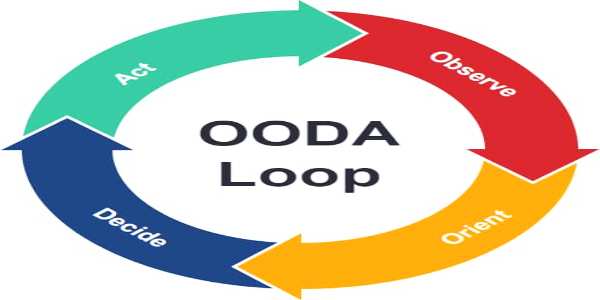
With the addition of AI models, there will be an update to how the OODA Loop operates and interacts in each of its stages. These interactions will affect decision-making in critical moments as follows:
Observation: Begins with monitoring the environment and collecting data, where AI plays a role in analyzing big data.
Orientation: AI orients the observation data to analyze patterns and trends.
Decision: The decision is made based on AI recommendations, facilitating decisions in critical moments.
Execution: The AI-analysis-based decision is executed.
Results Evaluation: After execution, results are evaluated, and feedback is looped back to the AI for continuous model improvement.
The OODA Loop remains a profound lesson that the speed of decision-making and the quality of orientation are the true secrets to superiority—not just in the pilot's cockpit but in every situation requiring rapid adaptation to a changing reality.
The Relationship of the OODA Loop to Success, Planning, and Organization.
The OODA Loop is an effective strategic tool for achieving superiority in combat operations by enhancing planning, organization, decision-making speed, and continuous training. It serves as a fundamental program for using modern defense systems, especially against new threats like unmanned aerial vehicles and hypersonic weapons, as decision-making in a single moment is essential in defense. Data-based OODA loops, often relying on AI, help achieve this by providing immediate decision support for threat detection, assessment, and rapid response, dynamically adapting to rapidly changing information.
In addition to its military use, the OODA Loop has proven to be a theory with numerous promising applications outside the military field, including business, healthcare, and technology. For example, major companies like Dell and Miracle-Gro engaged in OODA-inspired decision-making processes and succeeded in their commercial competitions, achieving substantial profits.
The OODA Loop can also assist government agencies or humanitarian teams in making quick and effective decisions during crises, such as natural disasters or epidemics. Through rapid observation and orientation, concerned parties can better understand the situation and identify necessary actions.
In business management, the OODA Loop is an effective means to accelerate decision-making. Company managers can use this model to understand market changes faster, helping them adapt quickly to customer needs and changing economic conditions, improve operational efficiency, reduce costs, increase productivity, and develop more flexible strategies, enhancing companies' ability to compete in unstable, challenge-filled work environments.
